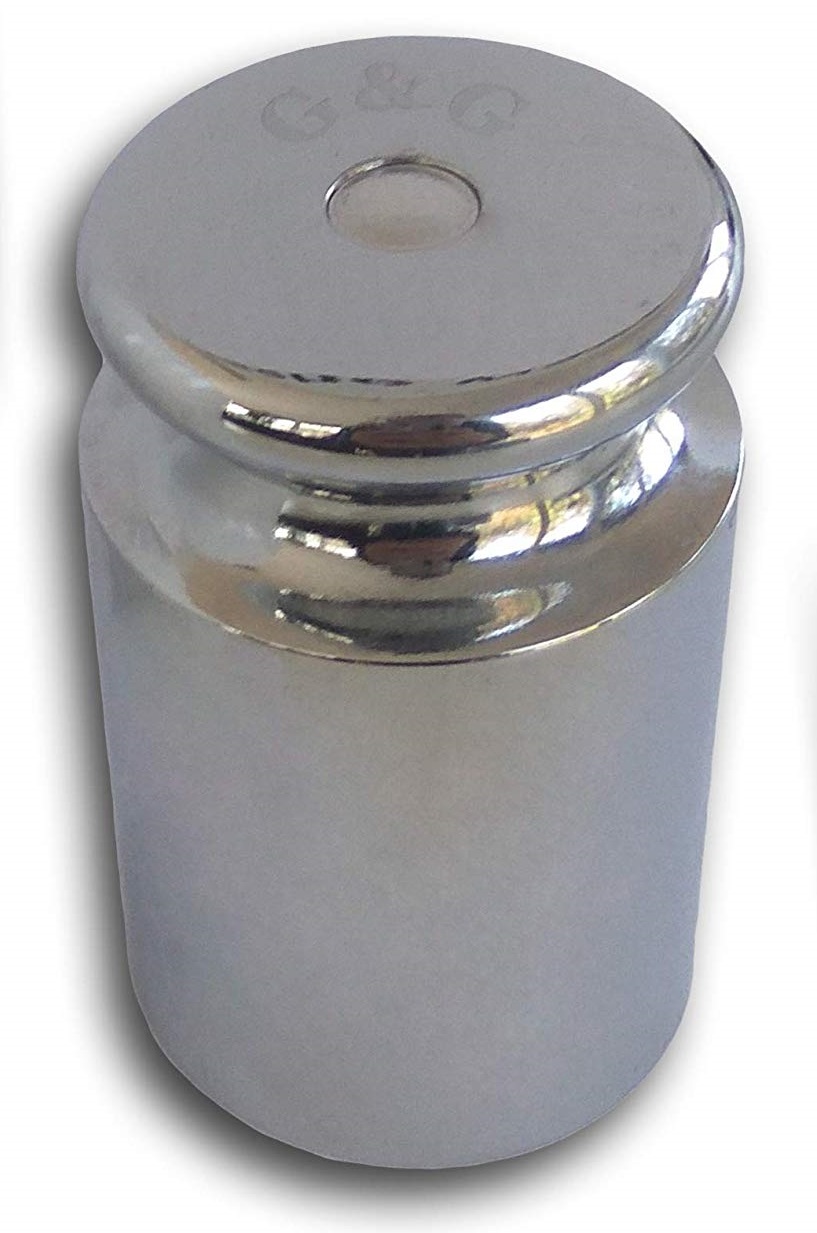
Each of our digital scales can be readjusted, from the small, inexpensive precision scales to the professional laboratory scales.
What is an adjustment?
During the adjustment, the scale "learns" how heavy the weight of a known object (e.g. our weight pieces) is under the current environment conditions and then readjusts itself.
We recommend performing the first adjustment after the arrrival of a newly ordered scale. This optimally adjust the scale to the local environmental conditions and avoids deviations that may have occurred during Transport during shock or vibrations and temperature influences.
During use, the scale should be readjusted periodically, especially after a significant temperature fluctuation.
With which weight?
The mass of the required reference weight is specified by the scale. A scale with a 100g measuring range requires a 100g weight, a 200kg scale requires a 200kg weight—or 20 stacked 10kg weights. Of course, adjusting a 200kg scale with a single 0.1kg weight is not possible.
Many scales also feature a "multi-point adjustment" to improve linear deviation and can (or must) be adjusted with two or more weights.
You can find out which weight you need for your scale from the data sheet and the instructions.
We offer scales for which regular testing and adjustment is particularly important and useful as a set, "Scale + Weight."
Accuracy classes:
In order for the scale to function accurately again after adjustment, the reference mass must have a lower production deviation than the scale can determine.
The maximum possible deviations correspond to the error limits classified by the OIML as measuring instrument type "R 111":
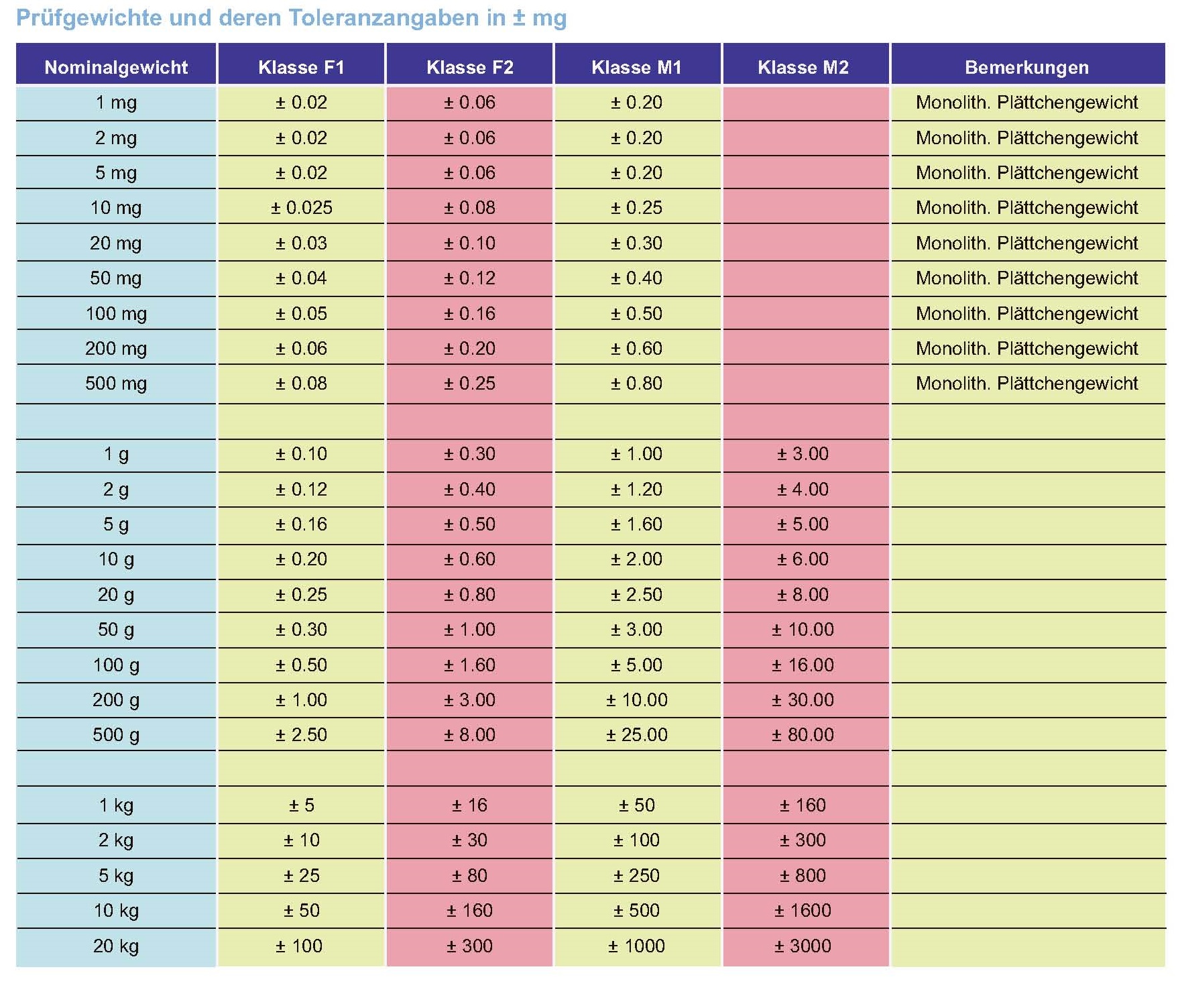
Download tolerance table as PDF.
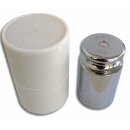
Our inexpensive weights are chrome-plated iron weights that are adjusted to a very low production tolerance within class M2 using a sealed adjustment chamber.
Note: These iron weights have a maximum deviation within class "M2," but they are not official OIML weights. This is irrelevant for the pure adjustment of a scale; however, it would not be possible to certify these weights with the Weights and Measures Office.
These are followed by finely turned stainless steel weights, which are turned and polished from a single piece of steel until the respective deviation is achieved. Weights in classes M1, F2, F1, or E2 (cheapest to most expensive) are possible.
The material also makes a difference; stainless steel weights are steel alloys with non-magnetic properties. On a scale that uses a strain gauge load cell, the material hardly matters, and inexpensive iron weights can be used.
Scales with a force compensation sensor (our JJ-BC & JJ-BF series) have an electromagnet built in that makes the weighing surface "float."
If you were to test this scale with an iron weight, the weight could be attracted or repelled by the magnet, distorting the measurement.
The higher the quality grade selected, the lower the attractive force a magnet can exert on the steel of the test weight.
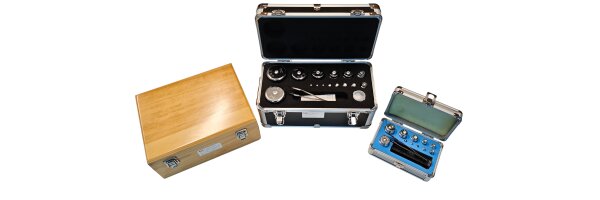
If you want to test the scale across its entire measuring range, we recommend a test weight set.
This also makes sense if you own several scales with different measuring ranges, as we can offer a set of multiple weights at a lower price than several individual weights (based on the price per weight).
Scope of delivery & protective case:
Each weight is delivered in a suitable protective case, which can also be used for permanent storage.
Small, inexpensive iron weights are housed in a plastic sleeve to protect them from scratches and dirt. The large, heavy weights (10 kg and above) are housed in a sturdy, padded case with carrying handles.
The polished stainless steel weights come in a padded protective case.
Each set is delivered in a matching case, available in wood or aluminum. Cases with a total weight of more than 10 kg have sturdy side carrying handles.
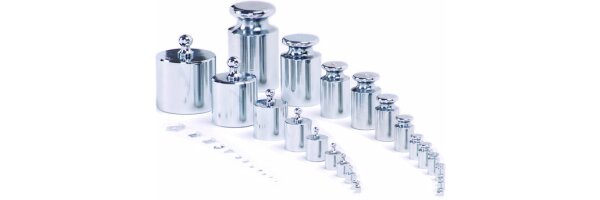
Individual weights are particularly suitable when it comes to...